
what the trees are teaching me
A note before you read: this piece has been weeks in the making. It started with learning about stress wood-that sparked my curiosity. I sat down to write and it grew from there, branching off in more directions than I expected. I lost the thread more times than I can count. It stretched me.
What The Trees Are Teaching Me
One of the most surprising discoveries in the Biosphere 2 project had to do with wind's role in a tree's life. Stress wood — the denser tissue that forms in response to wind and environmental pressure — is essential.
The trees inside the dome grew rapidly, faster than trees outside. But they also fell over before reaching maturation. After examining the root systems and bark, scientists realized that the lack of wind had caused a deficiency of stress wood. Stress wood helps a tree position itself for optimal sun absorption and grow more solidly.
Without stress wood, a tree can grow quickly but cannot hold itself up.
The trees needed stress in order to thrive in the long run.
We do too. Sometimes without even knowing it, we may build our own domes — drawn to the familiar, the safe, the known. Doing the best we can. There is nothing wrong with this. And yet — that quiet flatness. The loops grow tedious. A sense that something is off, something is missing but you can't quite name it. Or perhaps something louder —a knowing that the way you've been coping just isn't working anymore. An overprotective dome can keep out the very things that make us alive — the stretch, the real intimacy, the wonder and mystery, the messy alive range of being here.
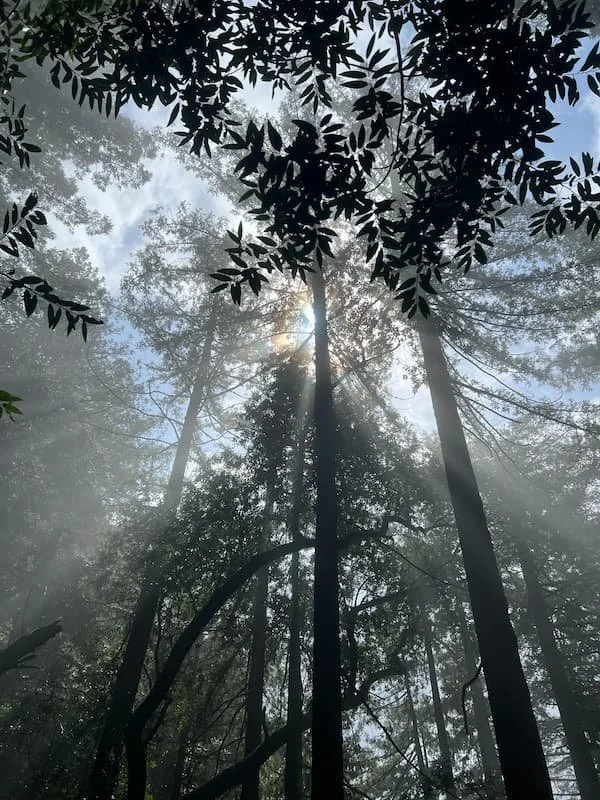
Photo of Oakland Redwoods by me
Have we been pathologizing stress? I know I did.
For much of my life I lived that way — calm and competent on the surface, bobbing along. People knew me as friendly, responsible, steady, kind. And I was all of those things. But underneath — a whole different story. The gap between what was allowed to be visible and what was actually happening inside — that incongruency was its own kind of pain. It just felt like life. I didn't know I had a choice. I just thought — this is just it. This is life. I sort of set up shop there.
Mine was a rather chilly one: a dome of ice. Thick cold walls with the sharp judgemental voice echoing down the corridors, keeping the unacceptable emotions on lockdown. Crying was permitted. Anger was not. It didn't disappear though. It just leaked out in ways I didn't even recognize as anger.
There was often an undercurrent. And every time I felt it — the distress, the tension, the unease — it was judged. There was that voice — What is wrong with you? You shouldn't feel this way. Just get on with it. Anything that didn't fit neatly behind the walls became evidence that something was wrong with me. Not information. Not a natural response. Proof of my own brokenness. And so the feelings stayed stuck.
Discomfort and vulnerability felt dangerous. And mostly, I avoided them. Who wants to feel the fear, the anxiety, the shame that seems to come with growth? I didn't. Not knowing then that these feelings weren't the enemy — just tangled up with judgement. And at first I didn't even know what I was avoiding — I just knew something felt unbearable to be with. That avoidance — the suppression — that was the actual stress. Not because avoidance is wrong or bad — it was protective. But suppression takes enormous energy and keeps the feelings frozen. And yet by bringing that suppressive pattern into the light — honoring it and learning, with a patient persistence and compassion, to orient to it differently — those thick walls began, slowly, to melt.
And there was something else — I was becoming tired of my own stories. The loops were growing tedious. Something was percolating underneath — a longing to take off the blinders. To explore. To come home to something I couldn't yet name.
The self created dome stopped feeling like safety. The staying had become more painful than the opening.
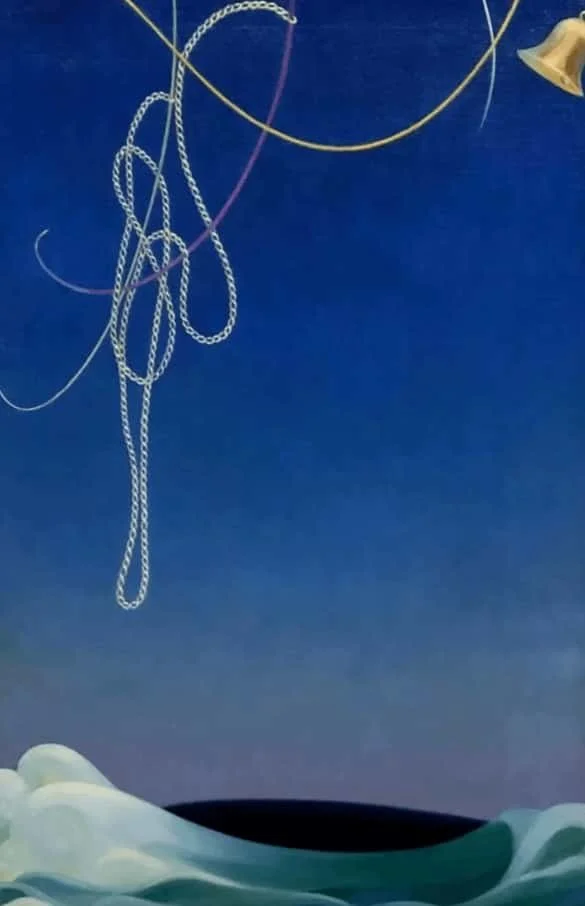
Painting by Agnes Pelton, Voyager
The very thing I had been avoiding became the portal to my own homecoming. Turning toward what I'd been avoiding — the harsh critic, the anxiety, the overwhelm — slowly, gently, with curiosity and compassion as my guides. Qualities forged by the distress itself — courage, and a compassion that is real because I am living it. The medicine, I was learning, lives right next to the poison.
At times it felt monumental. So much fear. But slowly, gently, I learned to summon a willingness to feel what I hadn't been willing to feel before. Bit by bit. Learning to cultivate the skill to be with what felt overwhelming — to stay in the room with it just a little longer each time.
I learned to say hello to what had been suppressed — to listen, to tend, to offer a sacred apology. I'm so sorry. I haven't known how to be with you, care for you. Restarting. And it was the somatic component that was the game changer. Not thinking about it — thinking wanted to judge, to fix, to analyze, to have an opinion. But dropping into the actual felt sense of it — that opened a world I didn't even know existed.
This kind of turning toward can begin anywhere, anytime with a pause, gentle inquiry and remembering how to connect to our soma/felt sense. I have a coach, teachers, and an Archetypal Somatics practice that gives me the tools and framework to go to these places safely, sustainably. And something larger holding us all— the earth beneath our feet, steady and present, the original loving container. Remembering that we belong to something vast and living. All of that companionship on the path makes all the difference.
One of the practices that has been most transformative is Somatic Recapitulation — a natural, organic process of meeting our painful past not in the thinking mind but in the body itself. When we think our way back we can get lost in the wound. But when we meet it through sensation, — what is present here, now while suspending our judgement — we become the Witness, the compassionate companion. More often than not, something has opened, shifted.
And what I discovered — and continue to discover — is that what we most avoid is often where we are most alive.
Learning to be with my own discomfort instead of running from it — that's when I began to turn toward the child I once was, to hold her hand. Before challenging moments I find her. And when I feel that familiar anxiety, that overwhelm — I've learned to pause and recognize. Oh. There she is. That recognition alone — small as it sounds — changes everything. I can do the hard thing WITH her, not swept away by her fear, not leaving her behind. She's mine to care for. And she has become my greatest ally. This scared kid, taken seriously at last, brings me back to her innocence, her trust, her playfulness, her sensitivity. Gifts submerged under the weight of all that judgement. Rediscovered on a path walked with heart.
As I built that capacity — to be with the discomfort, to let the feelings move, express and consciously integrate — energy that had been slowly leaking away began to surface. Not because I found it but because I stopped fighting it. Got curious. Included it. And in being included, it could move. Available now to follow what calls us forward — positioning ourselves, like the trees, toward what nourishes us. Toward the stress that stretches us, the wind that grows us.
I am learning to ride the waves — the symptoms, the activation, the fear and discomfort. Not enemies to be defeated but messengers waiting to be heard.
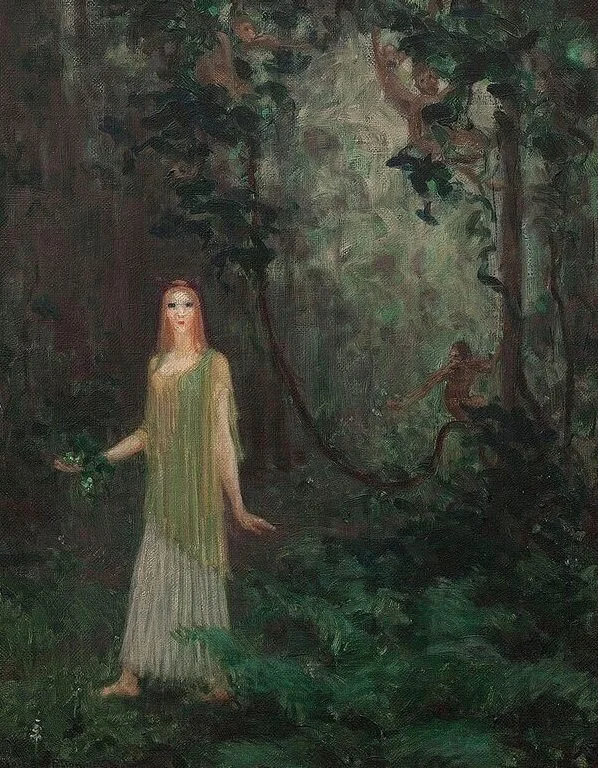
Painting by Agnes Pelton, Vine Wood
There have been many moments of choosing to be seen. This is one of them.
My heart was pounding. My thoughts were racing. Every fear showed up — of being seen as I am. Imperfect. Shaky. Not having it all together. Not good enough. Raw and unpolished. But I did it anyway — not because I had to, but because I wanted to. Because something in me chose growth over false safety. That thumping heart was telling me something important: This matters to me. This is my offering, my expression. No performance needed. Just me, as I am. Human, vulnerable, real. And unlearning a lifetime of performing, fawning, pleasing — that doesn't happen overnight.
I still feel the wobble. The old stories wanting to pull me back. But I'm learning to bend and bow, rooting down like the tree. And when I do get swept away — there is something to return to now.
For years, what felt like anxiety when I was about to share or express myself was actually a mix of both — genuine fear from the child I once was, who learned that speaking up could lead to rejection or ridicule, AND excitement about sharing something vulnerable and real — not polished, not performed.
When I started recognizing this wasn't present-day danger — that both were happening, the old fear AND the current excitement — I could turn toward the child I once was. Let her know I've got her. That she's here with me now. Both belong. Both are part of my growth.
By avoiding the discomfort of that activation, I thought I was freeing myself from anxiety. But I was actually enslaved by it — letting it dictate what I could and couldn't do. The moment I started to pause and get curious, everything began to shift.
There is a difference between the stress that stretches us and the kind that slowly drains us — energy with nowhere to go. I know that second kind intimately. That was me, bobbing along, suppressing and judging every flicker of discomfort, every wave of pain. And yet that very state — accepted at last for what it was — became my initiator. My invitation into maturity. The crack in the dome that let the love in.
But in our fear of ALL stress, we've lost the ability to discern what's actually building us versus what's depleting us. Befriending that fear itself — befriending even the avoidance — that's the trailhead.
When we can meet what arises with curiosity instead of alarm — when we can, as my mentor says, relate to it as emergence rather than emergency — we begin to become the loving container for what was always alive in us — waiting to be recognized. We are now learning to discern what is ours to tend and what is not ours to carry. Remembering to say hello to what belongs to us. Slowly — not all at once, not in a straight line — these difficult emotional states — once enemies to be avoided — become messengers, teachers, old friends finally allowed in from the cold.
When we can see our racing heart preparing us to express something that matters, to take a risk that's worth taking, to stretch toward something we actually want — everything changes.
The practice might begin with questions like these:
Am I meeting this with curiosity and compassion, allowing it to show me what it needs?
Or am I caught in the judgement, in the old stories — the conditioning, the inherited beliefs about who I'm supposed to be?
And perhaps most simply: can I say hello to what is present?
We forget. We fall asleep. We get swept away sometimes. And then we remember. And we begin again rising from foundations we have bravely tended with our own hands.
